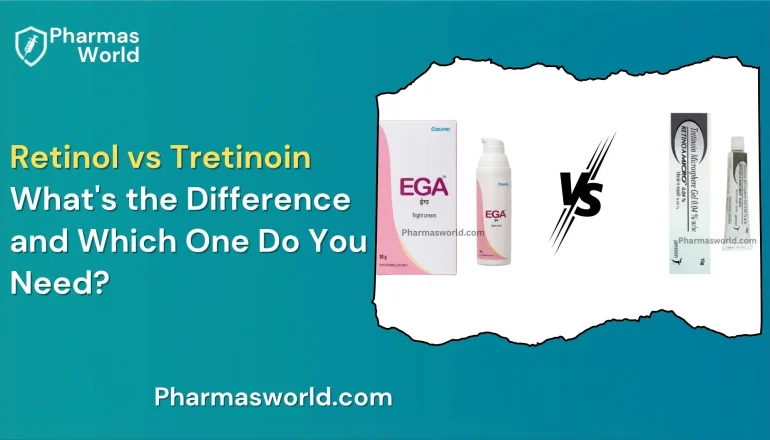
Let's be honest – the skincare world is confusing. You scroll through Reddit threads, watch YouTube dermatologists, and somehow end up more confused than when you started. And the biggest debate that never seems to die? Retinol vs Tretinoin.Both come from Vitamin A. Both promise younger, clearer, glowing skin. But they are NOT the same thing. Not even close.If you've been going back and forth trying to figure out which one actually deserves a spot in your nighttime routine, you're in the right place. No fluff. No complicated science jargon. Just real talk about what works, what doesn't, and what YOUR skin actually needs.Let's get into it.
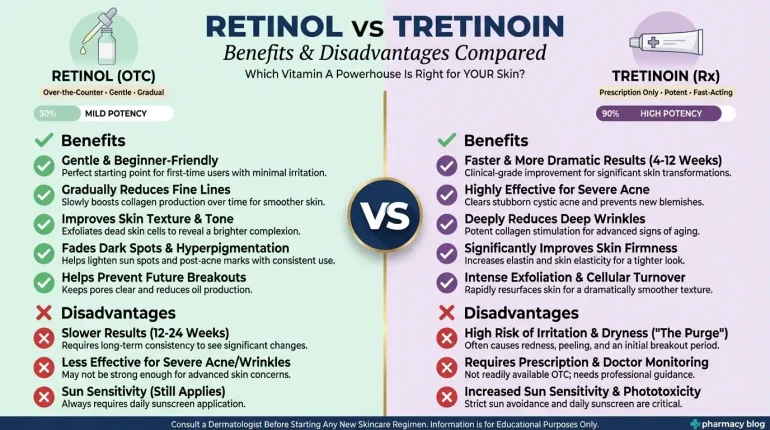
Think of retinol as the "gentle introduction" to the world of Vitamin A skincare. It's available over the counter – meaning you can grab it off the shelf at any drugstore, Sephora, or right here on PharmasWorld.com without a prescription.Here's the catch, though. Retinol doesn't work on your skin directly. When you apply it, your skin has to convert it into retinoic acid (the active form) before it can actually do anything. That conversion process takes time, which is why results with retinol are slower and more gradual
But that's not necessarily a bad thing.Because retinol is milder, it causes less irritation. It enhances radiance, smooths out fine lines over time, and improves your overall complexion without making your face feel like it's on fire
For someone who's never touched a retinoid before, retinol is a solid starting point.
Bottom line: Retinol = over the counter, gentler, slower results, great for beginners.
Now we're talking about the heavy hitter.Tretinoin is a synthetic form of Vitamin A, and here's what makes it different – it's already in its active form. Your skin doesn't need to convert it into anything. It gets absorbed and goes straight to work at the cellular level
That's exactly why tretinoin works faster and delivers stronger, more noticeable results. We're talking real improvements in acne, deep wrinkles, hyperpigmentation, and even conditions like psoriasis
But – and this is a big but – tretinoin is only available by prescription
You need to see a dermatologist or doctor to get it. There's a reason for that. It's potent, and if you use it wrong, your skin will let you know. Redness, peeling, dryness, irritation – the infamous "retinoid purge" is very real with tretinoin.Fun fact: tretinoin was actually the first retinoid ever discovered, and it remains the most studied and researched one out there. It's considered roughly 10 to 20 times more potent than an equivalent concentration of retinol
Yeah, that's a massive difference.
Bottom line: Tretinoin = prescription only, stronger, faster results, not for the faint-hearted.
| Feature | Retinol | Tretinoin |
|---|---|---|
| Availability | Over the counter | Prescription only |
| Potency | Mild to moderate | 10-20x stronger than retinol |
| How It Works | Converts to retinoic acid on skin | Already active – works immediately |
| Speed of Results | Weeks to months | Noticeable within a few weeks |
| Irritation Level | Low to moderate | Moderate to high |
| Best For | Beginners, sensitive skin, maintenance | Acne, deep wrinkles, pigmentation |
| Price | Affordable OTC options | Varies (requires doctor visit) |
Okay, if acne is your main concern, let's not sugarcoat it – tretinoin wins this round hands down.While there is some data showing retinol can help acneic skin, tretinoin is simply the more reliable option for treating breakouts
It unclogs pores faster, reduces inflammation more effectively, and has decades of clinical research backing it up.In fact, here's something a lot of people don't realize – retinol can actually make acne worse in some cases, especially if you have acne-prone or rosacea skin
That's a big deal, and most skincare brands won't tell you that on the label.So if you're dealing with stubborn, persistent acne that just won't quit, talk to your derm about tretinoin. It's prescribed specifically for severe acne and hyperpigmentation for good reason
Here's where things get a little more nuanced.Both retinol and tretinoin are effective for anti-aging. They both boost collagen production, speed up cell turnover, and help reduce fine lines and wrinkles over time.The difference? Speed and intensity.Tretinoin will get you there faster. If you're looking at deeper wrinkles, sun damage, and significant hyperpigmentation, tretinoin delivers results that retinol simply can't match at the same pace
.But if you're in your late 20s or early 30s and just starting to notice the first signs of aging – a few fine lines here, maybe some uneven texture there – retinol can absolutely do the job. It's gentler, you can use it long-term without much hassle, and it won't wreck your skin barrier in the process.Think of it this way:
Let's talk about the not-so-glamorous part.
Most people tolerate retinol pretty well, especially if you start with a lower concentration and build up gradually
These side effects are more intense, but they usually calm down after 4-6 weeks as your skin adjusts. The key is to start slow – maybe every other night or even every third night – and always, ALWAYS use sunscreen during the day.

Let me make this stupid simple for you.
Technically, you shouldn't use retinol and tretinoin at the same time. That's a recipe for a destroyed skin barrier.But here's a smart approach some dermatologists recommend: start with retinol to get your skin used to Vitamin A, then graduate to tretinoin when your skin can handle it. Think of retinol as training wheels before you hop on the motorcycle.Some people also use tretinoin a few nights a week and retinol on the off nights, but honestly, that strategy should only be done under a dermatologist's supervision. Don't DIY this one.
No matter which one you choose, these rules apply:
Yes. Tretinoin is about 10 to 20 times more potent than retinol because it's already in its active form and doesn't need any conversion by your skin.
No. Using both at the same time can damage your skin barrier and cause severe dryness, redness, and peeling. Stick to one at a time.
Tretinoin. It works deeper to unclog pores and reduce inflammation. Retinol can sometimes make acne worse in acne-prone skin types.
Retinol: 8–12 weeks. Tretinoin: 4–6 weeks. Tretinoin shows results faster because it's already in active form.
Yes. Tretinoin is prescription-only in the US. Retinol is available over the counter at most drugstores and online.
1. Cosmelite Cream A skin-brightening cream that helps reduce dark spots, melasma, and uneven skin tone. Perfect for those looking to pair their retinoid with a targeted pigmentation treatment.
2. Isofeel 0.025 Cream Contains Tretinoin 0.025% a gentle-strength prescription retinoid ideal for beginners dealing with acne and rough skin texture
3. Retino-A 0.025 Cream One of the most trusted tretinoin creams on the market. Great starting point for first-time tretinoin users targeting fine lines and acne.
4. Aziderm Cream 20% (15 gm) Contains Azelaic Acid 20% works alongside retinoids to fight acne, reduce redness, and fade post-acne dark marks. A perfect companion product.
5. Isofeel 0.1 Gel A higher-strength Tretinoin 0.1% gel for experienced retinoid users who need stronger results for stubborn acne and deeper wrinkles
6. Retino-A Micro 0.04 Gel Uses microsphere technology that releases tretinoin slowly into the skin meaning less irritation with the same powerful results. Best for sensitive skin that still needs prescription-strength tretinoin.
There isn't a "one-size-fits-all" answer here. Real research backs up both retinol and tretinoin as great substances. Your skin type, your worries, and how much discomfort you're ready to put up with will all affect which one is best for you.
If you're new to skincare, start slowly with an excellent retinol product. If you've been playing for a while and want to level up