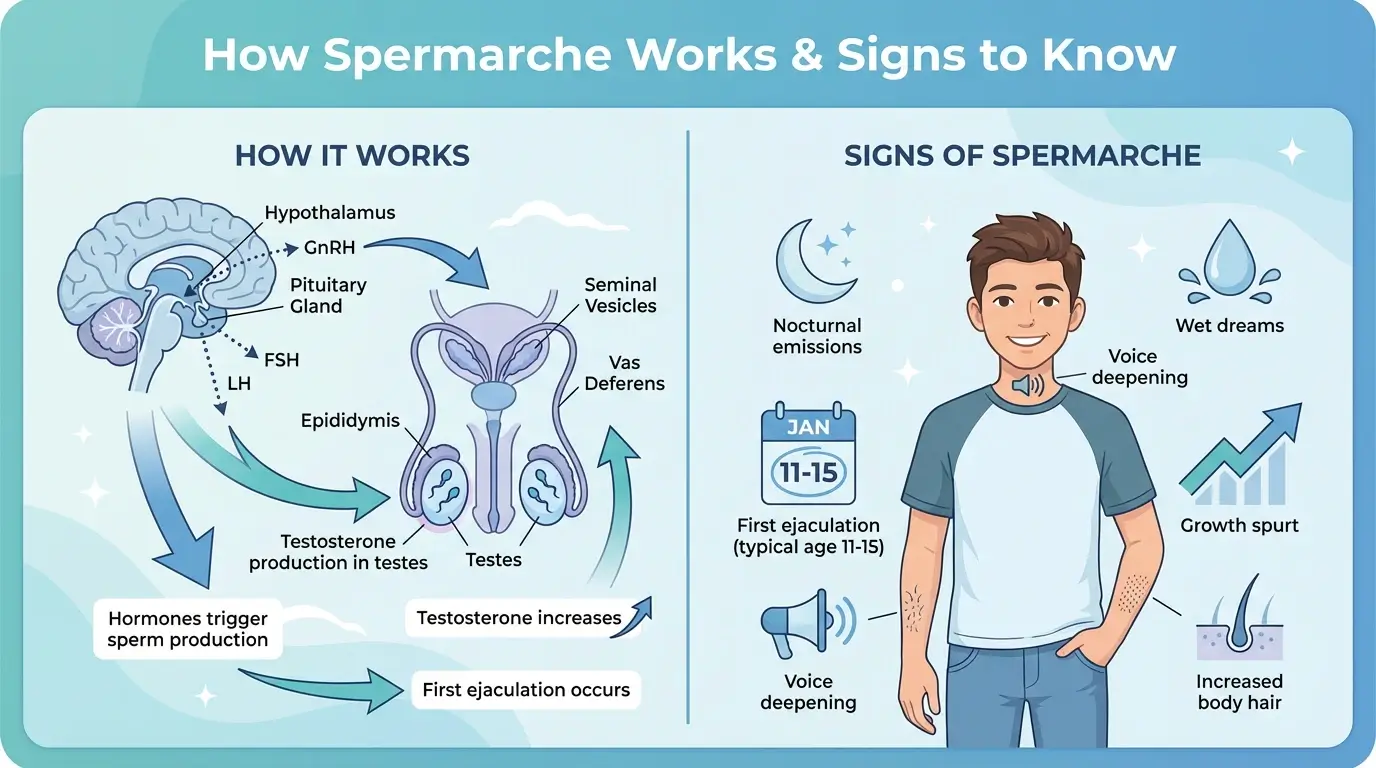
Puberty is a time of big changes for every child, and for boys, one of the most important but least talked about changes is spermarche. Most parents and teachers know what menarche is (a girl's first period), but they don't talk about what happens to boys. Boys may feel puzzled, nervous, or even afraid when this happens because they don't talk about it.
This complete explanation will explain what spermarche is, how it works, when it usually happens, and why it's important to know about it. This article has all the information you need about a boy's first ejaculation, whether you're a parent, teacher, or young person looking for answers.
Spermarche is the first time a boy ejaculates, which means he can start having children. It is the male equivalent of menarche in females. The name stems from the Greek words sperma (seed) and arche (beginning).
This usually happens around adolescence and means that the testes have started to make sperm. The first ejaculation might happen while you sleep (a nocturnal emission or wet dream) or in various ways.
Spermarche is a typical biological process that shows that a boy's body is growing up and his reproductive system is starting to work.
Spermarche can happen at any age, however it commonly occurs between 11 and 15, with an average age of 13. This may fluctuate depending on several factors:
Remember that early or late spermarche is usually not a cause for concern unless there are other unusual indications.
Learning about the biological mechanism behind spermarche makes this important event less mysterious. Here's a step-by-step guide on how it works:
The hypothalamus in the brain starts to release Gonadotropin-Releasing Hormone (GnRH) during puberty. This tells the pituitary gland to make two important hormones:
The testes start making more and more testosterone. This hormone is what makes boys' bodies change during puberty. Their voices get deeper, they grow body hair, their muscles get stronger, and their genitals get bigger.
FSH and testosterone make the seminiferous tubules in the testes start to make sperm cells. This process is called spermatogenesis, and it takes about 64 to 72 days for one sperm cell to fully develop.
The body can ejaculate once it has made enough sperm and seminal fluid. The initial ejaculation may happen as:
After spermarche, the body keeps getting better at reproducing. Early ejaculations may have less sperm, but as the boy gets older, the number and quality of his sperm will rise.
Boys and their parents might check for these signals that spermarche is coming soon:
Boys, parents, and society as a whole can all benefit from knowing about and learning about spermarche.
Boys are less likely to be terrified or bewildered when they ejaculate for the first time if they know what to expect. Knowledge gives you confidence instead of fear.
Boys can have a healthy relationship with their developing bodies if they know that spermarche is a natural part of growing up.
Talking openly about spermarche in families fosters trust and gives males a secure place to ask concerns about their health and growth.
Boys who know about nocturnal emissions and ejaculation are better able to keep their bodies clean during adolescence.
Understanding spermarche early on is the first step toward getting more complete sexual and reproductive health education later on.
When boys and their parents know about these things, they can spot possible problems, including delayed puberty or hormonal imbalances, and get medical help right once.
Not teaching guys about spermarche can have a number of bad effects:
Boys who ejaculate for the first time without knowing what to expect may feel ashamed, guilty, or confused, which can hurt their mental health.
Without the right education, boys could get wrong ideas about their bodies and sexuality from unreliable sources like friends or the internet.
Not knowing about wet dreams and ejaculation can lead to bad cleanliness habits, which can cause skin irritation or infections.
Not talking about puberty makes it harder to discuss important health issues with parents and kids.
If you don't know about them, signs of abnormal development, such early or late spermarche, may go unnoticed, preventing you from getting medical care.
Boys who don't understand or are embarrassed by body changes may have low self-esteem or negative growth sentiments.

Talking about spermarche doesn't have to be weird. These are some useful tips:
No, spermarche is just one part of puberty. Puberty includes a lot of changes in hormones, emotions, and body parts. Spermarche, on the other hand, is the first time a boy ejaculates.
In some circumstances, yes. If a male ejaculates before the age of 9, it may be considered precocious puberty, and a healthcare professional should be consulted.
Yes. Wet dreams, often called nocturnal emissions, are one of the most prevalent methods for males to ejaculate for the first time. They are quite normal and nothing to worry about.
Yes, in a technical sense. Spermarche means that the body has started making sperm. But early ejaculations may have less sperm, and complete fertility takes time to mature.
You usually don't need to see a doctor unless spermarche happens very early (before age 9) or very late (beyond age 16), or if there are other worrying signs. Otherwise, it's a typical part of growing up.
Menarche is a girl's first period, and spermarche is a boy's first ejaculation. Both are important events in puberty that mark the start of reproductive ability, although they happen in different ways in the body.
Yes. Things like long-term stress, bad diet, being overweight, and being around chemicals that mess with hormones might change when puberty starts and, as a result, when spermarche starts.
Spermarche is a normal, healthy, and significant step in a boy's life. It's just as necessary to talk about a boy's first ejaculation as it is to talk about a girl's first period. We can help guys get through puberty with confidence, knowledge, and a good self-image by teaching ourselves and our kids.
If you're a parent, teacher, or doctor, you should start these talks early. A boy who knows a lot becomes a healthy, well-adjusted adult.
This material is purely for educational and informational purposes and does not give medical advice. If you're worried about how your child is growing, please talk to a certified healthcare expert.