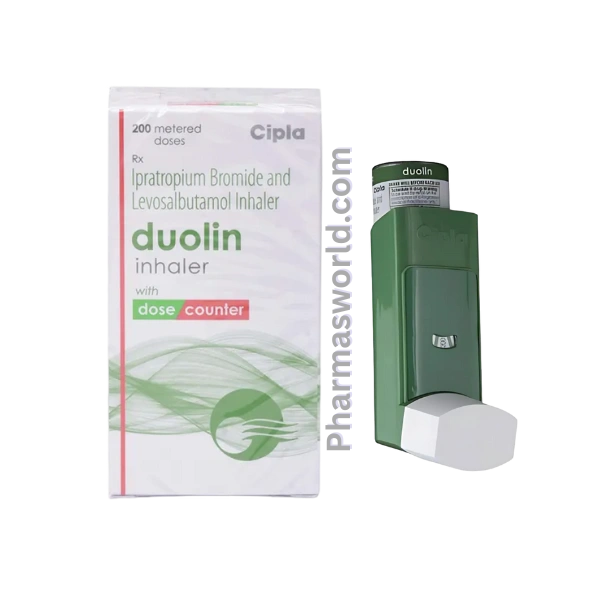
Duolin Inhaler 50 Mcg + 20 Mcg

Duolin Inhaler 50 Mcg + 20 Mcg

Price range: $38.03 through $99.39

Duolin Inhaler 50 Mcg + 20 Mcg is a combination reliever inhaler that typically contains levalbuterol 50 mcg and ipratropium bromide 20 mcg per puff. It is used to quickly open the airways during flare ups of COPD and, in some plans, asthma. Levalbuterol relaxes the airway muscles, while ipratropium reduces reflex tightening and mucus. Use exactly as directed, practice your technique or use a spacer, and keep a separate controller inhaler if your clinician has prescribed one. Rinse your mouth after use and know when to seek urgent care.

Duolin Inhaler 50 Mcg + 20 Mcg

Variant Price Units Quantity Add to Cart
3 Pack/s $38.03 $12.68
6 Pack/s $71.49 $11.92
9 Pack/s $99.39 $11.04

Limited Offer
20% Discount
PW20
Share:f𝕏win
🚚 Free Delivery🔄 Easy Returns✅ Genuine
Medically Reviewed By

Dr. Emily Carter

Senior Clinical Pharmacist

View Profile →
📋 Product Description
Duolin Inhaler 50 Mcg + 20 Mcg is a quick‑relief bronchodilator inhaler that pairs two proven medicines to help you breathe easier fast. The levalbuterol side acts on beta‑2 receptors to relax tight airway muscles, and the ipratropium side blocks cholinergic reflexes that cause spasm and mucus. When your chest feels tight, you are wheezing, or it is hard to get air out, this combination can take the edge off while your controller therapy does the long‑term work.

What it is used for

  • Symptom relief in chronic obstructive pulmonary disease (COPD), including chronic bronchitis and emphysema
  • Rescue use or pre‑exercise use in select asthma action plans when a clinician directs it
  • Short‑term relief of wheeze, cough, and chest tightness during viral or irritant‑triggered flares

How it works in simple terms

  • Levalbuterol (a short‑acting beta‑2 agonist) quickly opens the airway by relaxing the smooth muscle wrapped around your breathing tubes.
  • Ipratropium (a short‑acting anticholinergic) reduces reflex tightening and helps dry excess secretions a bit.
  • The combo can be more effective than either alone during some flares.

How to use it for best results

  • Typical directions adults receive: 1 to 2 puffs as needed for symptoms. Spacing is often every 4 to 6 hours when needed. Follow your exact plan.
  • Prime the inhaler if it is new or unused for the period shown in the patient leaflet. Sprays to prime do not count as doses.
  • Shake gently. Breathe out fully. Seal lips on the mouthpiece. Press the canister at the start of a slow, deep breath. Hold for about 10 seconds. Breathe out slowly.
  • A spacer or valved holding chamber can improve delivery to the lungs and reduce throat irritation, especially if timing is hard.
  • Track how often you need rescue doses. Using it more than your plan allows can be a sign you need a controller step‑up. Bring that note to your next visit.
  • Always keep your quick‑relief inhaler available. If you have an asthma or COPD action plan, follow the steps for yellow and red zones.

What to expect

  • Relief can begin within minutes and last several hours.
  • If you are not feeling better within 15 to 20 minutes, follow your action plan or seek care. For severe symptoms like blue lips, trouble speaking full sentences, or ribs pulling in with each breath, call emergency services.

Common side effects

  • Dry mouth or throat irritation
  • Fast heartbeat, tremor, nervous feeling, or headache
  • Cough right after a puff, hoarseness, or a funny taste
  • Less often: nausea, dizziness, or blurred vision if mist hits the eyes
Tip: keep the mouthpiece horizontal, look straight ahead, and avoid spraying toward the eyes. Rinsing and spitting after use can reduce throat irritation and bad taste.

Who should be cautious

  • People with glaucoma or at risk of narrow‑angle glaucoma should avoid getting spray in the eyes; ipratropium can worsen eye pressure if it contacts the eye
  • Those with prostate symptoms like urinary retention should report worsened difficulty urinating
  • Anyone with significant heart rhythm issues should discuss safe use, as beta‑agonists can raise heart rate

Key interactions to know

  • Other inhaled anticholinergics or short‑acting beta‑agonists can increase side effects when stacked
  • Non‑selective beta blockers (for example, propranolol) can blunt levalbuterol’s effect
  • MAO inhibitors, tricyclic antidepressants, and other sympathomimetics can intensify cardiovascular effects
  • Loop or thiazide diuretics together with frequent beta‑agonist use may lower potassium; your clinician will advise if you are at risk
Always share a complete list of prescriptions, over‑the‑counter products, and supplements.

Technique, priming, and cleaning

  • Prime per the leaflet when new or if not used for the specified interval
  • Clean the mouthpiece weekly with a dry tissue or as the leaflet directs; avoid soaking metal canisters
  • Replace when the dose counter reads zero or per the labeled actuations

Practical tips

  • Use your controller inhaler every day if prescribed; this reduces the need for rescue use
  • Limit smoke, dust, cold air, strong fragrances, and known personal triggers
  • Consider a peak‑flow meter and a written action plan; bring both to visits for quick tune‑ups
  • If you use multiple inhalers, ask your clinician about the best order and spacing

Available strengths and formats in the market

Depending on brand and region, combination bronchodilators are available as:
  • Levalbuterol 50 mcg + Ipratropium 20 mcg per actuation metered‑dose inhaler
  • Nebulizer solutions that combine albuterol or levalbuterol with ipratropium in unit‑dose vials
  • Comparable ipratropium 20 mcg + albuterol 100 mcg inhalers in certain markets
  • Single‑ingredient options your clinician might pair or substitute:
  • Albuterol or levalbuterol inhalers and nebulizer solutions
  • Ipratropium inhalers or nebulizer solutions

Storage and handling

  • Store at room temperature. Keep away from heat and open flame
  • Cap the mouthpiece between uses to keep dust out
  • Keep out of reach of children and pets

Helpful search phrases people use

Duolin inhaler how to use, levalbuterol ipratropium inhaler, rescue inhaler vs controller, inhaler spacer steps, priming and cleaning inhaler, COPD flare treatment, asthma quick relief, dry mouth after inhaler, eye protection with ipratropium, action plan yellow zone.

FAQs

Is Duolin Inhaler 50 Mcg + 20 Mcg a rescue or controller inhaler?

It is a rescue or quick‑relief inhaler. It helps during flares by opening the airways fast. Keep using your daily controller inhaler if one is prescribed.

How often can I use it?

Follow your label. Many adults use 1 to 2 puffs every 4 to 6 hours as needed. Needing it more often can mean your condition is not well controlled. Call your clinician or follow your action plan.

Can I use a spacer with this inhaler?

Yes. A spacer or valved holding chamber improves delivery to the lungs and reduces throat irritation. Ask a clinician or pharmacist to check your technique.

What if the spray gets in my eyes?

Ipratropium can worsen narrow‑angle glaucoma and cause blurred vision if it reaches the eyes. If it happens, rinse gently with water. If you have painful red eye or vision changes, seek care.

What if I feel my heart racing after a puff?

A faster heartbeat or tremor can occur with beta‑agonists. Sit, breathe slowly, and monitor. If symptoms are strong, persistent, or you have chest pain or fainting, seek medical care and notify your clinician.
size3 Pack/s, 6 Pack/s, 9 Pack/s
Reviews

Reviews

There are no reviews yet.

Be the first to review “Duolin Inhaler 50 Mcg + 20 Mcg”

Your email address will not be published. Required fields are marked *

Related Products

Tiova Rotacaps 18 Mcg

Tiova Rotacaps 18 Mcg

Price range: $13.94 through $37.62
Beclate Inhaler 200 Mcg

Beclate Inhaler 200 Mcg

Price range: $13.60 through $36.80
Asthalin HFA Inhaler 100 Mcg (200 mdi)

Asthalin HFA Inhaler 100 Mcg (200 mdi)

Price range: $8.28 through $21.96
Seroflo Inhaler 25 Mcg + 250 Mcg

Seroflo Inhaler 25 Mcg + 250 Mcg

Price range: $20.16 through $55.44