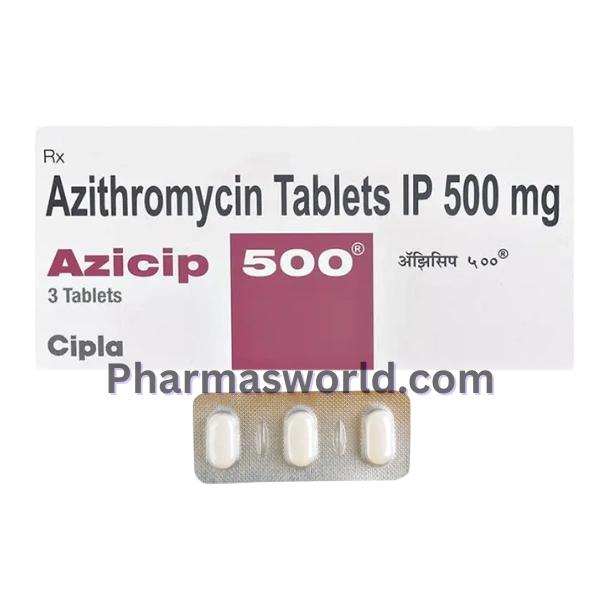
Azicip 500 Mg Tablet

Azicip 500 Mg Tablet

Price range: $31.80 through $90.90

Azicip 500 Mg Tablet is a prescription antibiotic that usually contains azithromycin 500 mg, but it’s always worth confirming the active ingredient on your strip or box. Azithromycin is used for certain bacterial infections such as respiratory infections, sinus or throat infections, some skin infections, and other doctor-confirmed cases. It does not treat viral colds or flu. Taking it exactly as prescribed and completing the course helps reduce the chance of the infection coming back.

Azicip 500 Mg Tablet

Variant Price Units Quantity Add to Cart
30 Capsule/s $31.80 $1.06
60 Capsule/s $61.80 $1.03
90 Capsule/s $90.90 $1.01

Limited Offer
20% Discount
PW20
Share:f𝕏win
🚚 Free Delivery🔄 Easy Returns✅ Genuine
Medically Reviewed By

Dr. Emily Carter

Senior Clinical Pharmacist

View Profile →
📋 Product Description
Azicip 500 Mg Tablet is one of those medicines people often look up right after they’ve been diagnosed with a bacterial infection and want to know what they’re putting in their body. You’ll see searches like “azithromycin 500 mg tablet,” “antibiotic for chest infection,” “sinus infection antibiotic,” “throat infection medicine,” or “how to take azithromycin.” That’s the lane Azicip sits in. Most brands sold as Azicip are known to contain azithromycin. Since brand names can sometimes differ by supplier, check the label so you’re 100% sure the active ingredient is azithromycin 500 mg.

What Azicip 500 Mg Tablet is typically used for

Azithromycin is a macrolide antibiotic. Doctors may prescribe it for certain bacterial infections, including:
  • Respiratory tract infections (some bronchitis cases, certain pneumonias)
  • Sinus or throat infections when bacteria are suspected or confirmed
  • Ear infections in some cases
  • Skin and soft tissue infections
  • Some sexually transmitted infections, depending on diagnosis and local guidance
The key detail is that it’s meant for bacteria, not viruses. If you take it for a cold, flu, or most sore throats caused by viruses, it won’t help and can contribute to antibiotic resistance.

How it’s usually taken (without giving you a personal dosing plan)

Azithromycin has a long half-life, which is why it’s often prescribed in shorter courses than some other antibiotics. Your clinician might prescribe it as a multi-day plan that could be a steady dose each day, or a higher first-day dose followed by a lower dose on the next days. The exact schedule depends on what’s being treated and your medical history, so follow the prescription label rather than copying a regimen you saw online. Practical tips people find helpful:
  • Take it at the same time each day to make it easier to remember.
  • Some people can take it with food to reduce nausea.
  • If you use antacids containing aluminum or magnesium, spacing them away from azithromycin may be recommended. Ask a pharmacist because it depends on the product.

Why finishing the course matters

Even if you feel better fast, bacteria can still be hanging around. Stopping early is a common reason infections return, sometimes harder to treat the second time. If side effects are making it tough to continue, call your prescriber instead of quitting on your own. There may be options.

Side effects people commonly notice

A lot of people do fine on azithromycin, but the most common side effects are stomach-related: If you get severe diarrhea that’s watery, persistent, or comes with fever or blood, get medical advice quickly. Rarely, antibiotics can trigger a more serious gut infection (C. difficile).

Safety warnings that are worth knowing

Azithromycin can affect heart rhythm in some people by prolonging the QT interval. That does not mean it’s unsafe for everyone. It just means you should tell your clinician if you have:
  • A history of QT prolongation or irregular heartbeat
  • Low potassium or low magnesium
  • Heart failure or significant heart disease
  • You take other meds known to affect QT (some antiarrhythmics, antipsychotics, certain antidepressants, some antibiotics)
Also, if you develop a rash, hives, swelling, or trouble breathing, treat that as a possible allergic reaction and seek care.

Interactions and “don’t guess” situations

If you take blood thinners (like warfarin), heart rhythm medications, or multiple prescription meds, it’s smart to ask a pharmacist for an interaction check. Also mention liver disease, since azithromycin is processed through the liver.

What to do if it doesn’t seem to work

If symptoms are not improving after a couple of days, or they’re getting worse, it might be the wrong antibiotic for the bacteria involved, or it might not be a bacterial infection at all. That’s not a reason to take extra tablets. It’s a reason to call your clinician for reassessment.

Available Strengths (as available in the market)

Azithromycin is commonly available in several strengths and forms, including:
  • Tablets: 250 mg, 500 mg
  • Dispersible tablets (in some markets): 500 mg
  • Oral suspension: 100 mg/5 mL, 200 mg/5 mL
  • Higher-dose options (like 1 g total dosing for specific uses) may be available depending on formulation and prescriber instructions
Availability can vary, so match the exact strength and form to your prescription.

FAQs

1) What is Azicip 500 Mg Tablet used for?

Azicip 500 Mg Tablet is usually azithromycin 500 mg, used for certain bacterial infections such as respiratory, throat, sinus, or some skin infections when prescribed.

2) Will Azicip 500 Mg work for a cold or flu?

No. Colds and flu are viral. Antibiotics like azithromycin do not treat viruses.

3) Can I take Azicip 500 Mg with food?

Many people can, and it may help with nausea. Follow your label directions, and ask a pharmacist if you’re also using antacids.

4) What should I avoid while taking azithromycin?

Avoid mixing it with other medicines that affect heart rhythm unless your clinician approves. Also be careful with antacids containing magnesium or aluminum and ask about spacing doses.

5) What are serious side effects I should watch for?

Seek medical help for allergic reactions (hives, swelling, breathing trouble), severe persistent diarrhea, or symptoms like fainting and rapid or irregular heartbeat.
size30 Capsule/s, 60 Capsule/s, 90 Capsule/s
Reviews

Reviews

There are no reviews yet.

Be the first to review “Azicip 500 Mg Tablet”

Your email address will not be published. Required fields are marked *

Related Products

Champix 1 Mg Tablet

Champix 1 Mg Tablet

Price range: $111.16 through $330.12
Azee DT 100mg

Azee DT 100mg

Price range: $23.00 through $54.00
Augmentin Duo 625 mg

Augmentin Duo 625 mg (Amoxicillin / Clavulanic acid)

Price range: $60.00 through $131.00
Azax 500 Mg

Azax 500 Mg

Price range: $18.47 through $68.25