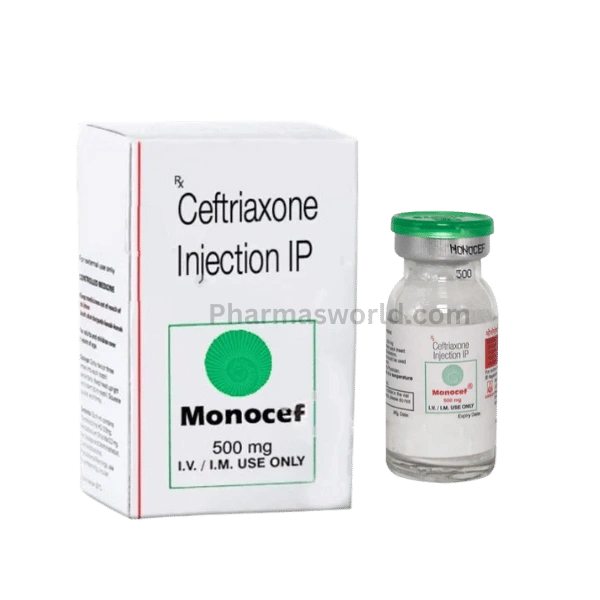
Monocef 500 Mg Injection

Monocef 500 Mg Injection

Price range: $3.78 through $18.89

Monocef 500 Mg Injection is commonly supplied as ceftriaxone 500 mg, a third‑generation cephalosporin antibiotic given by a healthcare professional for moderate to severe bacterial infections. It is administered by IM or IV route after proper reconstitution and should not be self‑injected. Follow your prescriber’s plan for dose and schedule, finish the full course, and report allergic reactions, severe diarrhea, or unusual pain. Tell your care team about all medicines and any history of penicillin or cephalosporin allergy.

USA Brand Name Rocephin
Strength 500mg
Generic Name Ceftriaxone Sodium
Manufacturer Aristo Pharmaceuticals, India

Monocef 500 Mg Injection

Variant Price Units Quantity Add to Cart
1 Injection $3.78 $3.78
3 Injection $10.51 $3.50
6 Injection $18.89 $3.15

Limited Offer
20% Discount
PW20
Share:f𝕏win
🚚 Free Delivery🔄 Easy Returns✅ Genuine
Medically Reviewed By

Dr. Emily Carter

Senior Clinical Pharmacist

View Profile →
📋 Product Description
Monocef 500 Mg Injection is often a ceftriaxone 500 mg sterile powder for injection used to treat confirmed or strongly suspected bacterial infections. Because brands can vary, always check your vial label for the exact active ingredient and follow professional direction. Ceftriaxone is a third‑generation cephalosporin that covers many gram‑negative and gram‑positive organisms and is used widely in hospitals and clinics.

What Monocef 500 Mg Injection is used for

  • Community‑acquired pneumonia and other lower respiratory infections
  • Complicated or uncomplicated urinary tract infections and pyelonephritis
  • Skin and soft tissue infections, bone and joint infections
  • Intra‑abdominal and biliary infections
  • Bacterial septicemia and meningitis when indicated
  • Certain sexually transmitted infections (e.g., single‑dose therapy for uncomplicated gonorrhea per guideline‑directed care)
  • Perioperative surgical prophylaxis in select procedures

How it works in simple terms

Ceftriaxone inhibits bacterial cell wall synthesis. Without a functional cell wall, bacteria can’t maintain structure and die. As the bacterial load drops, fever, pain, redness, and other infection symptoms improve.

How it is given

  • Route: intramuscular (IM) or intravenous (IV) by a trained professional.
  • Reconstitution: prepared with compatible diluents (sterile water or normal saline for IV; 1% lidocaine may be used for IM to reduce discomfort—lidocaine solutions are never given IV).
  • Administration notes: IV doses are infused over the time recommended by the facility protocol. Do not mix or administer simultaneously with calcium‑containing IV solutions in the same line; flush lines thoroughly if both are used at different times.
  • Do not self‑inject. Dosing and frequency depend on the infection, your kidney and liver function, and culture results.

Important safety points

  • Allergy: do not use it if you've had a serious allergic reaction to ceftriaxone or other cephalosporins. Cross‑reactivity with penicillins can occur; tell your clinician about any penicillin allergy.
  • Newborns: ceftriaxone is generally avoided in hyperbilirubinemic neonates due to kernicterus risk and must not be given with calcium‑containing IV solutions in neonates.
  • Biliary effects: ceftriaxone can cause biliary sludging or gallbladder “pseudolithiasis,” more often with higher doses; report right‑upper abdominal pain, jaundice, or persistent nausea.
  • C. difficile: severe, persistent diarrhea or abdominal cramps can indicate C. difficile–associated diarrhea. Seek care promptly.
  • Hematologic: rare immune hemolytic anemia has been reported; contact your clinician if you notice unusual fatigue, shortness of breath, or dark urine.

Common side effects

  • Injection‑site pain, redness, or swelling
  • Mild diarrhea, nausea, abdominal discomfort
  • Headache, dizziness, or rash
  • Transient changes in liver or kidney tests on labs
Seek urgent care for anaphylaxis (hives, wheeze, swelling), severe or bloody diarrhea, chest tightness, or extreme weakness.

Drug and solution interactions

  • Calcium‑containing IV solutions: do not co‑administer with ceftriaxone in the same line due to precipitation risk; flush lines between agents and follow facility policy.
  • Warfarin and other anticoagulants: INR may change; monitoring can be required.
  • Aminoglycosides: may be used together for synergy in specific infections but require kidney function monitoring.
  • Alcohol: not a specific disulfiram‑type interaction with ceftriaxone, but alcohol can worsen dehydration and recovery; keep it modest while ill.
Always share a full list of prescriptions, OTCs, and supplements with your care team.

What to expect during treatment

  • Many people feel better within 24 to 72 hours as fever and pain decrease.
  • Even if you feel improved, do not skip doses or leave treatment early; completing the prescribed course helps prevent relapse and resistance.
  • If symptoms are not improving by day 3, or if they worsen, your team may review cultures, imaging, and antibiotic choices.

Who should discuss extra precautions

  • People with prior severe beta‑lactam allergy, gallbladder disease, kidney or liver impairment
  • Patients on blood thinners or with bleeding risks
  • Those with a history of C. difficile infection
Your clinician will tailor the dose and monitoring plan for these situations.

Storage and handling (facility guidance)

  • Unreconstituted vials: store per label, typically at room temperature away from light and moisture.
  • Reconstituted solutions: use within the time window specified in the product insert and facility protocol.
  • Keep all injections out of reach of children. For clinical use only.

Available strengths and related options in the market

  • Ceftriaxone injection vials: 250 mg, 500 mg, 1 g, 2 g
  • Ceftriaxone + sulbactam combinations (various strengths) for beta‑lactamase–producing organisms when indicated
Your prescriber will select the exact strength and regimen based on infection type, culture/susceptibility results, and clinical guidelines.

Helpful search phrases people use

Monocef 500 mg injection uses, ceftriaxone 500 mg IV vs IM, reconstitution with lidocaine, ceftriaxone calcium warning, ceftriaxone side effects, ceftriaxone for pneumonia, single dose ceftriaxone gonorrhea, ceftriaxone biliary sludge, ceftriaxone vs cefotaxime, third‑generation cephalosporin.

FAQs

What is Monocef 500 Mg Injection used for?

It is commonly a ceftriaxone 500 mg injection used for bacterial infections such as pneumonia, UTIs, skin and soft tissue infections, intra‑abdominal infections, sepsis, and in some cases for STIs or surgical prophylaxis, as directed by a clinician.

How is Monocef 500 Mg Injection given?

By a trained professional as an IM or IV dose after proper reconstitution. Do not self‑inject. The dose and frequency depend on your infection and lab results.

Are there important warnings with calcium solutions?

Yes. Do not co‑administer ceftriaxone with calcium‑containing IV solutions in the same line and never together in neonates. Lines should be flushed between agents and facility policy followed.

What side effects should I report right away?

Signs of a severe allergy (hives, swelling, wheeze), severe or bloody diarrhea, new jaundice or right‑upper abdominal pain, unusual bruising, or extreme fatigue.

Can I drink alcohol during treatment?

There’s no specific disulfiram‑type reaction with ceftriaxone, but alcohol can worsen dehydration and delay recovery. It’s best to keep intake minimal while being treated for infection.
size1 Injection, 3 Injection, 6 Injection
Reviews

Reviews

There are no reviews yet.

Be the first to review “Monocef 500 Mg Injection”

Your email address will not be published. Required fields are marked *

Related Products

Neckcin 500 Mg Tablet

Neckcin 500 Mg Tablet

Price range: $49.20 through $93.60
Cefadrox 500 Mg Tablet

Cefadrox 500 Mg Tablet

Price range: $52.97 through $114.74
Almox 500 Mg Capsule

Almox 500 Mg Capsule

Price range: $28.20 through $43.20